
Damp Walls and Rendering: What Actually Fixes the Problem
Every autumn in Cornwall we get calls about damp walls. Some of those calls turn into render jobs; some of them don't — because the damp isn't coming from where people think it is. Getting this diagnosis wrong before you render is how you end up with the same problem, or a worse one, inside two years.
There is more than one type of damp
The word “damp” gets used to describe three quite different problems: penetrating damp, rising damp, and condensation. They have different causes, different signs, and different fixes. Rendering over the wrong type of damp doesn't solve it — it covers it up temporarily and usually makes it worse by trapping moisture inside the wall structure.
Cornwall's wet winters make all three more common than they'd be in a drier climate. The county gets significantly above average rainfall and the air humidity is high most of the year. Old solid-wall stone buildings were designed to manage moisture by breathing — absorbing and releasing it naturally. When that process gets interrupted by the wrong materials, problems follow.
Penetrating damp
Penetrating damp is water getting into the wall from the outside. It comes through cracks in existing render, through failed pointing in exposed masonry, through gaps around window and door frames, or through porous or spalling render that's absorbing driven rain rather than shedding it. It typically shows up as damp patches that appear or worsen during or after heavy rain, and they're usually on the wall faces that take the most weather — west or north-facing in Cornwall.
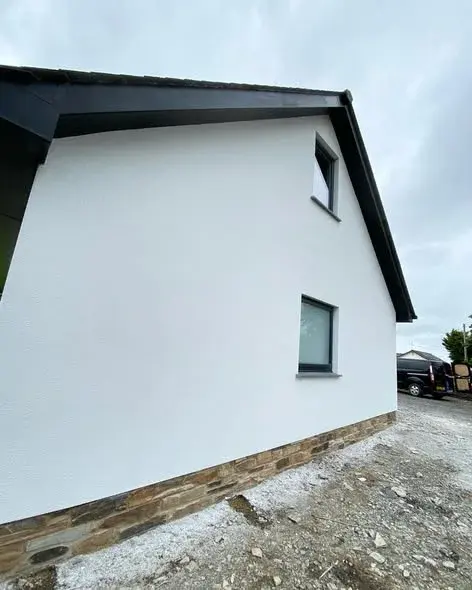
This is the type of damp that rendering fixes. If the external wall surface is the source of the ingress — cracked render, no render, porous masonry — then a new render system applied onto a properly prepared substrate will stop the water getting in. Silicone render is particularly effective because its hydrophobic surface actively repels water rather than just presenting a physical barrier.
Rising damp
Rising damp is groundwater being drawn up through the wall by capillary action. It typically appears as a damp tide mark on internal walls, usually to a height of no more than a metre above floor level. You often see white salt staining on the plaster, peeling wallpaper near the skirting, and sometimes a musty smell at the base of the wall. Critically, it doesn't get worse during rain — it's present regardless of the weather.
Rising damp is caused by a missing or failed damp proof course, or by ground levels that have been raised above the existing DPC. In very old Cornish stone buildings without any DPC at all, the wall material itself was porous enough to allow the moisture to evaporate out before it caused problems — but that relied on breathable lime plaster internally and lime render externally, not cement.
Diagnose before you do anything
When we come out to look at a property with damp walls, the first thing we want to establish is the pattern. Where is the damp? How high does it reach? Does it change with the weather? Is it present on all external walls or just one elevation? Is there a tide mark, salt staining, or just generalised moisture? Are there cracks in the external finish we can see directly?
If the damp tracks with rain events and is worst on the most exposed elevation, that's penetrating damp and the external wall surface is the place to start. If it's consistent year-round and concentrated low down on internal walls, we're going to suggest a damp specialist looks at the DPC situation before we talk about render. Rendering over rising damp is a waste of money and usually makes the internal damp worse.
When rendering actually fixes the problem
New render is the right call when the external wall surface is the source of the water ingress. Failed or cracked cement render that's allowing rain to penetrate. Old pointing that's fallen out or is badly weathered. An unrendered stone wall that gets hammered by Atlantic rain. All of these are genuine penetrating damp causes that a new render system addresses directly.
The key is proper preparation. If the existing render is failed, it needs to come off. We won't render over loose or delaminating material — it won't bond, and in five years you'll have the same problem. The substrate gets cleaned, any cracks in the underlying masonry get repaired with a suitable filler, and the render system goes onto a sound, clean base. That's what makes the fix last.
When rendering makes it worse
Cement render over rising damp is the classic mistake. The cement doesn't stop the moisture coming up through the wall — it stops it getting out. The moisture accumulates inside the wall, the internal plaster gets wetter, and salt crystallisation starts breaking down both the new render and the masonry behind it. Properties where this has happened need both the external render and the internal plaster stripping back, which is an expensive repair.
The same logic applies to putting cement render over old cob or stone walls with rising damp. Traditional Cornish building materials like cob, rubble stone and earth mortar were designed to work with breathable finishes. Encasing them in cement traps moisture and can cause the wall structure itself to deteriorate. We've seen cob walls behind cement render that were soft and crumbling where the moisture had nowhere to go.
Lime render and damp: the old way that still works
For old Cornish stone and cob buildings with any history of damp, lime render is often the right external finish. Lime is breathable — it allows moisture vapour to pass through the wall in both directions, which is exactly how these buildings were designed to work. It doesn't trap moisture, so the wall can dry out naturally after wet weather.
Lime also has another useful property: it's soft and slightly flexible compared to cement, so it doesn't lock moisture into the wall and it allows minor movement without cracking. Traditional lime renders on well-maintained old cottages in Cornwall have been doing their job for a hundred years. The maintenance requirement is higher than silicone — you need to patch small cracks and repoint as needed — but on the right building, it's the system that's actually compatible with how the structure works.
The most common mistake we see
People see damp patches, assume the render has failed (sometimes correctly), and call someone to render straight over the existing wall without investigating the source. If the render isn't the source — if there's a gutter problem overhead, a failed DPC, or rising damp — the new render won't fix it. We've quoted on jobs where we've asked the customer to sort the gutter first and come back to us, because putting new render under a leaking gutter is a waste of everyone's money.
The other version is rendering with the wrong system — putting hard cement render on an old breathable wall, or skipping the investigation and assuming any crack must be letting water in. Most cracks in render are cosmetic and don't penetrate to the wall behind. A visual inspection and some probing tells you a lot before you start stripping anything.
Our honest verdict
Rendering can absolutely fix damp when the damp is penetrating from outside through a failed external finish. That's a good proportion of the damp calls we go to. But the diagnosis has to come first. Skipping that step — especially on old Cornish stone and cob buildings — risks making the problem significantly worse and significantly more expensive to put right.
If you've got damp walls and you're not sure what's causing it, give us a call and we'll come and have a look. If it's something render can fix, we'll tell you. If it isn't, We'll tell you that too.
Got a job in mind?
Call us on 07761 735022 or message on WhatsApp.
Related articles
Written by the PureRend team — plastering and rendering specialist in Bude, Cornwall.