
Can You Render Over Pebbledash? (And Should You?)
Last updated:
We get asked this a lot, particularly on 1960s and 1970s properties across Cornwall and Devon. The short answer is: yes, in most cases — but only if the pebbledash is actually sound. Here's how to tell.
The short answer
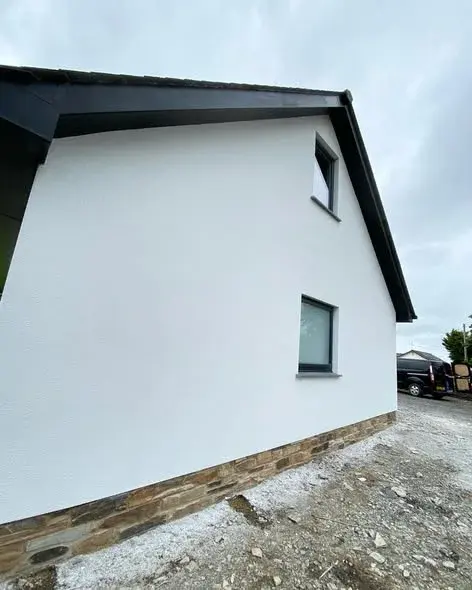
If the pebbledash is solid, well-bonded, and not showing signs of failure, you can apply a thin coat render systemover the top with mesh reinforcement. This is often the most cost-effective approach — it avoids the labour of hacking off the old material and gives a clean, modern finish.
If the pebbledash is blown (hollow or loose when you tap it), cracked, or failing in patches, it needs to come off first. Rendering over a failing substrate is a waste of money — the new render will fail too, usually within a couple of years.
How to tell if your pebbledash is sound
The simplest test: tap it gently with your knuckles or the handle of a screwdriver. Solid pebbledash sounds dead and dense. Blown or failing pebbledash has a hollow, drum-like sound — that tells you it's delaminated from the wall behind it.
Also look for:
- –Sections that are visibly cracked or separated at the edges
- –Areas where the stones have fallen away, leaving bare render
- –Long diagonal cracks running across the facade (often structural movement)
- –Damp patches inside the house that align with the external wall
- –Any previous patch repairs — these are a sign the render has had problems
- –Bowing or bulging when you sight along the wall from the corner
If you have any doubts, we can come and take a look. A quick tap test takes ten minutes and we'll tell you honestly what we find.
The four-step process when pebbledash is sound
- 01
Preparation
Clean the surface, treat any biological growth (algae, moss), and address any isolated failed spots. Small blown areas can be cut out, repaired, and keyed back in.
- 02
Prime
Apply a stabilising primer or bonding agent suitable for over-cladding. This gives the new render something to grip onto and bridges the textured surface.
- 03
Mesh reinforcement
Apply a base coat render and embed alkali-resistant fibreglass mesh throughout. This is the critical step — it holds the system together and prevents cracking, especially around windows, doors, and corners.
- 04
Topcoat
Apply the finished render — silicone, monocouche, or thin coat depending on the property and client preference. Through-coloured, so no repainting needed.
When it needs to come off
Watch out for cowboys who skip this step.We've seen render jobs that were done over completely failed pebbledash — looked fine for 18 months, then started bulging and falling off. Stripping the wall properly before rendering is not optional when the substrate is bad.
If a significant portion of the pebbledash is blown — say more than 20–30% — it's usually better to strip the whole lot. Trying to patch and render over a patchwork of good and failed material creates inconsistencies in the final finish and weak points where the new render can delaminate.
Stripping adds labour cost and some disposal cost, but it means you're starting with a clean, honest substrate and the new render has the best possible base to bond to. On a 3-bed semi, expect 2–3 days for stripping plus skip hire on top of the render price.
Why this comes up so much in Cornwall
Cornwall has a huge stock of 1960s and 1970s housing — estates and individual properties — that were built with pebbledash as standard. After 50–60 years, a lot of that render is reaching the end of its life. The coastal climate doesn't help: freeze-thaw cycles, salt spray, and persistent damp accelerate the delamination process.
The good news is that stripping the old pebbledash and applying a modern render system completely transforms these properties. A fresh silicone render on a well-prepared wall will last decades and look far better than any repainted pebbledash.
What affects the cost
Render-over with a silicone thin-coat system on sound pebbledash is quoted per job once we've assessed the surface. If stripping is needed, that adds labour and disposal (skip hire, plus a couple of days' work on a typical semi). For more on what moves the price in Cornwall, see rendering cost in Cornwall.
Got a job in mind?
Call us on 07761 735022 or message on WhatsApp. Ten minutes on site and we'll tell you whether your pebbledash can be rendered over or needs to come off.
Related articles
Written by the PureRend team — plastering and rendering specialist in Bude, Cornwall.