
How to Clean Render Without Damaging It
Last updated:
Living on the North Cornwall coast, we see algae-covered render regularly. The temptation is to hit it with a pressure washer. Don't. It's the single most damaging thing you can do to modern rendered walls. Here's what works instead.
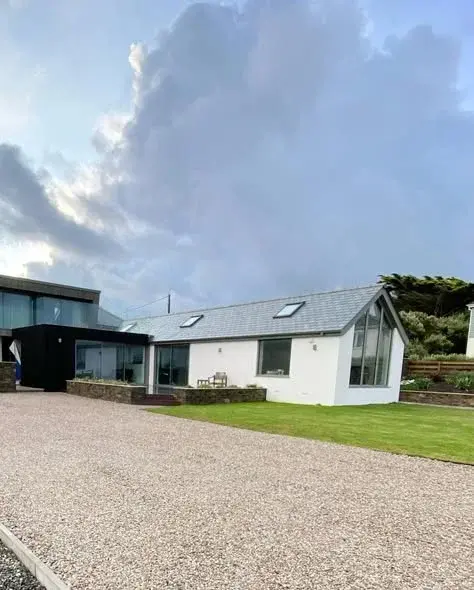
Never pressure wash your render
High-pressure water strips the microscopic hydrophobic layer off the surface of silicone and monocouche renders. This destroys the self-cleaning properties, voids most manufacturer warranties, and leaves the surface porous — meaning algae and moss come back significantly faster the following year.
Why algae appears (and why it's normal)
In Cornwall's climate — damp, mild, relatively little direct sun on north-facing walls — algae, moss, and lichen will eventually settle on almost any rendered surface. This doesn't mean something has gone wrong with the render.
Modern silicone renders have self-cleaning properties that slow this process down considerably compared to older cement renders — the hydrophobic surface makes it harder for biological growth to get a foothold. But on the wrong aspect (north-facing, in shade, near trees), even the best render will need cleaning eventually.
The question isn't whether algae will appear. It's how you deal with it when it does.
What actually works: soft-washing
Soft-washingmeans applying a diluted biocide or fungicide solution at very low pressure — roughly the same pressure as a garden hose. The chemicals do the work, not the water pressure. They kill the algae, moss, and lichen at the root level.
Here's what happens: the biocide is applied to the whole surface. The biological growth dies over the following few days. Rain then naturally washes the dead material off, leaving the render surface completely clean and — crucially — undamaged. The hydrophobic properties of the render remain intact.
This is the onlycorrect way to clean modern render. Anything involving high pressure — whether a pressure washer or a power washer “on a low setting” — risks damaging the surface.
How often does render need cleaning?
In Cornwall, we'd typically say every 3 to 5 years is a sensible interval for a soft-wash, depending on:
- →Aspect — north-facing walls in shade are worst affected
- →Proximity to trees — organic debris and shade accelerate growth
- →Coastal proximity — salt-laden air can encourage certain types of biological growth
- →The render system — higher-quality silicone renders slow growth more than basic systems
- →The colour — pale and white renders show algae sooner; mid-greys and warm creams disguise it longer
Can I do it myself?
For single-storey walls with light algae growth: yes. You can buy biocide solutions at most builders' merchants or online. Dilute according to the instructions, apply with a garden pressure sprayer at low pressure, and leave it to do its work. Don't rinse it off — let rain do that naturally over the next few weeks.
For heavy infestations, multi-storey properties, or anywhere that requires working at height: get it done professionally. The risk of damage from an incorrect application — or an accidental high-pressure blast — isn't worth the saving.
We offer soft-wash aftercare — it's something we can combine with a maintenance visit if you want someone to check the condition of the render at the same time.
What about the render manufacturer's warranty?
Most render manufacturer warranties — from major render manufacturers — explicitly exclude damage caused by pressure washing. If you pressure wash a rendered surface and something fails as a result, the manufacturer warranty is gone. Any reputable installer would say the same.
This isn't small print buried in a document — it's standard across the industry. Pressure washing and modern render systems do not mix.
Got a job in mind?
Call us on 07761 735022 or message on WhatsApp. We offer soft-wash aftercare across Bude and North Cornwall.
Related articles
Written by the PureRend team — plastering and rendering specialist in Bude, Cornwall.